
I Gede Boy Rekeyasa
February 7, 2020
What is Autonomous Translation?
Artificial Intelligent (AI) is one of the interesting issues regarding technological development today. There are several products of AI that could help people to do their daily activities and for business purposes. Translation technology is one of the Ai products that combine technology, information system, and communication. The history of translation technology will bring us back to the Cold War in the 1950s between the United States and Soviet Union when the functions of translation technology are mostly for military purposes (Marr, 2018). There are many files translated from the United States to the Soviet Union and vice versa due to the different language as the most important aspect to communicate or negotiate.
The high demand for translation needs improvement for efficiency. Nowadays, translation technology has improved to real-time translation called autonomous translation. The autonomous translation is the best example of AI technology in business and education that strongly related to student environment and information system which make this is an interesting topic to discuss. The autonomous translation is the real-time translation technology of human speech. This technology could help people to translate through their devices in a second. Several companies such as Google and Facebook have developed their translation assistant to make efficient communication between people from a different country or even helps the student to understand and translate sentences.
The problem is every system has the limitation to process the data including translation technology. Generally, Google translates and Facebook also has the limitation to translate the data. To solve that problem, Microsoft develops a new system that uses two main techniques to process the data which are: Statistical Machine Translation (SMT), and Neural Machine Translation (NMT). SMT is a machine translator approach with translation results produced on the basis of a statistical model, whose parameters are taken from the parallel text transcription analysis. Meanwhile, NMT as an adjustment of the SMT that can process data as a whole in such a way that it can produce a better quality of sentence because NMT does not translate by word but also pays attention to the relationship of words in a sentence (Microsoft, 2020). Those two processing techniques will allow people to translate in the bigger amount of data, and help people to have a higher quality of translation.
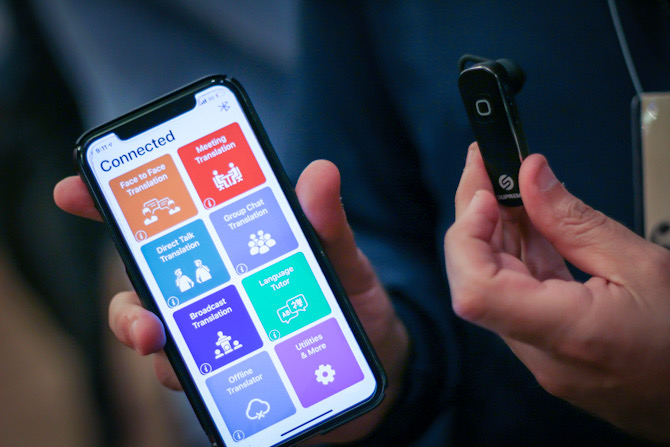
How real-time translation works?
After we elaborate on the definition and function of autonomous translation, the next question would be “how it works?” Before we break down the steps of how the machine helps us to translate, let us understand the concept of communication. According to the video, massages do not really travel, but they are using code. First, people need to encode messages by speaking. Then, communication needs some channels to transfer the massages. Finally, the receiver could receive the massages and encode them.
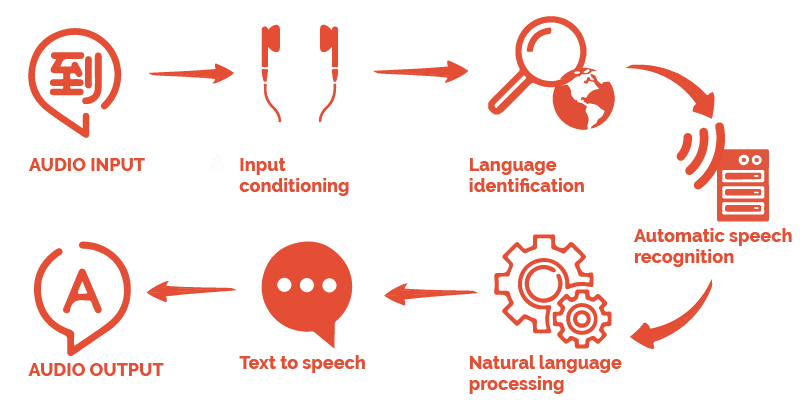
After understanding the concept of communication, now we are moving to a higher level of communication with technology. There are many communication revolutions by using technology. Smartphones as a common tool to help people to communicate in the digital era. Are you ready for the next level of communication technology? Rea-time translation technology is one of the examples of communication technology. Real-time translation allows people to communicate across language barriers. Here is the process of real-time translation in translating our languages.
- First, people speak trough devices (mobile phone or computer)
- Then, the speech recognition software process the sound by using the statistical algorithm to detect the meaning of our words.
- During the translation process, the statistical algorithm system also compares the words with another translated document or web pages to checks the accuracy of the translation.
- Finally, the system will produce words in the local language.
Is there any ethical issue regarding autonomous translation?
Besides the technical issue, autonomous translation also has ethical issues. There are two main ethical issues in autonomous translation, which are:
- The quality of translation
The quality in this term carries several aspects to be concerned, such as general ethics of translation, and the congeniality between text and its purpose. Due to the limitation system in translation technology, the machine will translate the data in the same type without examining the purpose of the translation. On the other hand, the professional human translator could analyse the purpose of translation and translate the data according to its purpose, whether it is for academic, business, formal or informal purposes (Taivalkoski, 2018). Although Microsoft has developed the new translation technology that could improve the quality of translation, still, that is not enough to cover the complexity of languages.
- AI will replace human translators
Due to the higher technology, easier to use, and lower cost of autonomous translation compared to the human translator, it will increase the demand for autonomous translation in the market. The fact will probably make a half-million human translator lost their job (Marr, 2018).
Conclusion
To conclude, an advance in technology could help people to do their jobs or even help people to communicate across the language barriers. As smart people, we should also consider the side effect and issues in using autonomous translation. So, do you think that autonomous translation will help people or vice versa?
References
Marr, B. (2018, 08 24). Will Machine Learning AI Make Human Translators An Endangered Species? Retrieved from forbes.com: https://www.forbes.com/sites/bernardmarr/2018/08/24/will-machine-learning-ai-make-human-translators-an-endangered-species/#237036139023
Microsoft. (2020, January 15). Machine Translation. Retrieved from Microsoft Web site: https://www.microsoft.com/en-us/translator/business/machine-translation/
Taivalkoski, K. (2018, September 24). Taylor & Francis Online. Retrieved from Ethical issues regarding machine(-assisted) translation of literary texts: https://www.tandfonline.com/doi/full/10.1080/0907676X.2018.1520907

 irekeyasaMIS304